
Wine Tasting Notes Template: A Simple Beginner-Friendly Format
Taking wine notes sounds more serious than it needs to be. You do not need to write like a sommelier. You do not need to identify every fruit, flower, spice, or tiny detail in the glass. And you definitely do not need to pretend you taste something just because someone else said it first. A good wine tasting note should help you answer one simple question:
Would I want to drink this wine again?
That is the whole point. This beginner-friendly wine tasting notes template gives you a simple structure you can use anytime you try a new bottle. It works whether you are tasting at home, ordering wine at dinner, visiting a winery, or trying to build a better sense of what you actually like.
And if you prefer writing by hand, you can use the printable version as a simple one-page guide. Want the simple version you can print and use right away? Download the free tasting notes template and use it the next time you open a bottle.
Why Use a Wine Tasting Notes Template?
Most people drink wine casually, enjoy it or dislike it, and then forget the details. That is the problem. You might remember that you liked “a red wine from Italy” or “a white wine with a green label,” but that usually is not enough to find it again or understand why you liked it. A simple tasting note gives you a record of what you tasted, what stood out, and whether the wine fits your preferences. Over time, those notes help you spot patterns.
Maybe you like crisp white wines with citrus flavors. Maybe you prefer smooth reds with softer tannins. Maybe you keep buying bold wines because they sound impressive, but you actually enjoy lighter reds more. That is where tasting notes become useful. They are not about sounding fancy. They are about making better wine choices.
If you are brand new to this, it also helps to understand the basics of [What Is a Tasting Note?] before using the template below.
The Simple Wine Tasting Notes Template
Use this format whenever you try a wine:
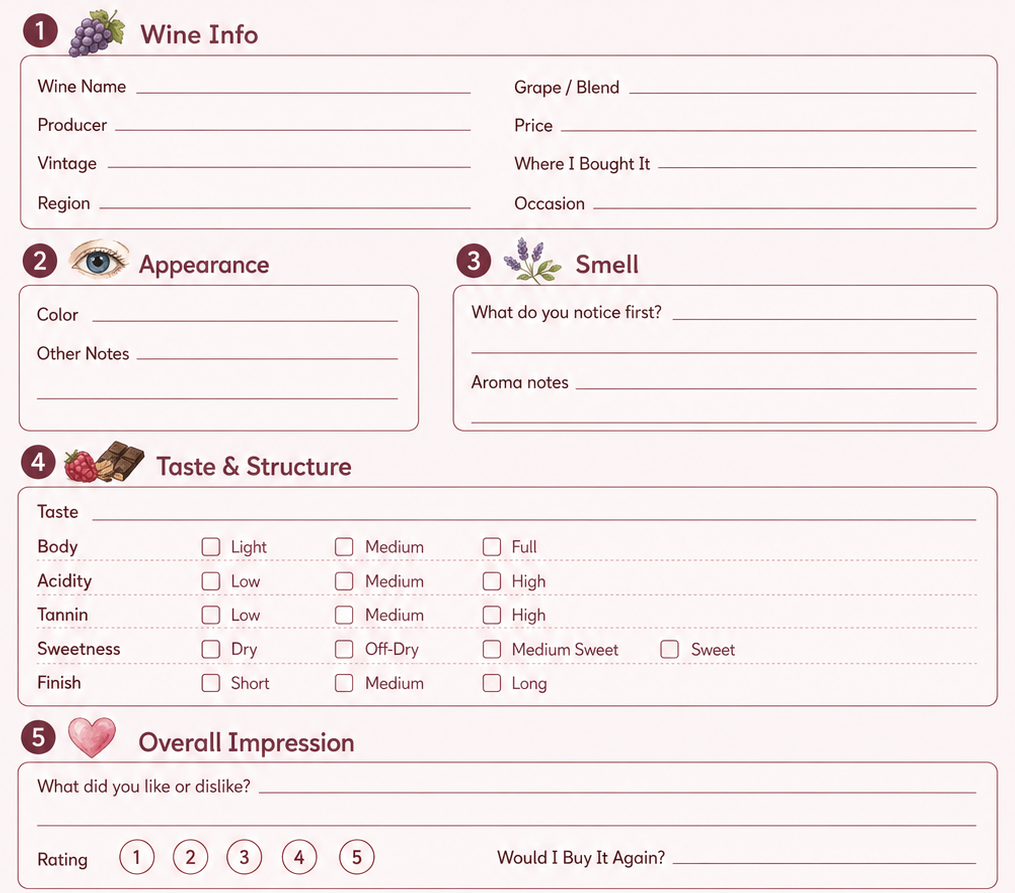
That might look like a lot at first, but you do not need to fill out every field perfectly. The goal is to capture enough information that your future self knows what the wine was like and whether it is worth buying again. Below is how to think about each section.
1. Wine Info
Start with the basic information from the bottle. This section does not need to be perfect. The goal is simply to write down enough detail that you can remember the wine later, find it again, or understand what types of bottles you tend to like. In this section, record:
Wine Name: The name on the bottle. This may be the producer, the wine name, the vineyard name, or a combination of all three. For example, Josh Cellars Cabernet Sauvignon or La Crema Sonoma Coast Chardonnay.
Producer: The winery or brand that made the wine. This is helpful because you may find that you consistently like certain producers, even across different bottles.
Vintage: The year the grapes were harvested. For most beginners, vintage does not need to be overthought, but it is still useful to write down. If the bottle does not list a vintage, you can write non-vintage.
Region: Where the wine came from. This could be broad, like California or Italy, or more specific, like Napa Valley, Willamette Valley, Rioja, or Marlborough. Region matters because place and climate can affect how a wine tastes.
Grape or Blend: The grape variety or blend used to make the wine. Examples include Cabernet Sauvignon, Pinot Noir, Chardonnay, Sauvignon Blanc, Merlot, Riesling, Syrah, and Malbec. If you do not know the exact grapes, writing red blend or white blend is fine.
Price: How much the bottle cost. This is one of the most practical details to track because it helps you remember whether the wine was actually worth the money. A $12 wine you love may be more useful to remember than a $45 wine that was just okay.
Where You Bought It: The wine shop, grocery store, restaurant, winery, or online retailer where you found the bottle. This makes it much easier to buy again later.
Occasion: When or why you opened the wine. This could be dinner at home, date night, a wine tasting, a holiday meal, or a casual weeknight bottle. Wine can feel different depending on the setting, so a quick occasion note gives your tasting note helpful context.
If the label is confusing, take a photo. That way, even if your written note is short, you still have the bottle saved for later.
2. Appearance
Appearance is what the wine looks like in the glass. For beginners, keep this simple. You do not need to analyze color like a professional taster. Just write the basic color and anything obvious.
Examples:
Pale yellow
Deep ruby
Light red
Golden
Dark purple
Clear and bright
For most casual tasting notes, one short phrase is enough.
3. Smell
Smell is where a lot of wine flavor starts. Before tasting, give the wine a swirl and smell it. Then write down the first few things it reminds you of. You might notice fruit, flowers, herbs, spices, oak, vanilla, butter, earth, or something fresh and citrusy.
Examples:
Smells like lemon, green apple, and fresh herbs.
Smells like blackberry, vanilla, and baking spice.
Smells fruity, bright, and a little floral.
Do not force it. If all you can say is “fruity,” that is still a valid note. For more help with this part, read How to Smell Wine.
4. Taste & Structure
This is where you write what the wine tastes like and how it feels in your mouth. Start with the main flavors you notice. Then add a few simple structure notes: body, acidity, tannin, sweetness, and finish. You do not need to get every detail right. The goal is to describe the wine in a way that helps you remember whether you liked it.
For the taste line, use everyday words. A note like “cherry, raspberry, and a little spice — light and smooth” is more useful than trying to force professional wine language.
Here are a few examples:
Tastes like cherry, raspberry, and a little spice. Light and smooth.
Tastes like lemon, green apple, and grapefruit. Crisp and refreshing.
Tastes like blackberry, plum, oak, and vanilla. Bold and dry.
If you are not sure what to write, words like fresh, smooth, sharp, heavy, juicy, dry, sweet, bitter, crisp, rich, bold, and easy to drink are all fair game.
For the structure part, keep it simple:
Body: How heavy or full the wine feels. Choose light, medium, or full. A Pinot Grigio may feel light-bodied, while a Cabernet Sauvignon may feel full-bodied.
Acidity: How fresh, crisp, tart, or mouthwatering the wine feels. Choose low, medium, or high. High-acid wines often make your mouth water and feel especially refreshing.
Tannin: The dry, grippy feeling mostly found in red wine. Choose low, medium, or high. If a red wine makes your mouth feel dry, tannin is probably part of the reason.
Sweetness: How sweet the wine actually feels, not just how fruity it tastes. Choose dry, off-dry, medium sweet, or sweet. A wine can taste like ripe fruit and still be dry.
Finish: What happens after you swallow or spit the wine. Choose short, medium, or long, or describe it naturally. For example, “the finish is smooth with a little spice” or “the finish is crisp and mouthwatering.”
This section is not about judging the wine perfectly. It is about building a clearer memory of the bottle. If you can describe the main flavors and the general feel of the wine, you are doing it right. For more structure, check out How to Taste Wine.
5. Overall Impression
This is the most important part of the tasting note because it turns all the details into a clear personal takeaway. After you write down what the wine looks, smells, and tastes like, finish with your honest reaction. Did you like it? Was it too bold, too sweet, too sharp, too oaky, or just right? Would you want to drink it again? A good overall impression does not need to sound fancy. It just needs to be useful. For example:
I liked this more than expected. It was smooth, fruity, and easy to drink.
Good wine, but a little too bold for me.
Refreshing and crisp. I would buy this again for summer.
Not bad, but I would not go out of my way to get it again.
Too oaky for my taste.
Then add a simple rating. A 1 to 5 scale works well for beginners:
1 = Did not like it
2 = Not for me
3 = Good enough
4 = Really liked it
5 = Loved it
The exact rating system matters less than using it consistently. If you rate one wine a 4, you should have a general sense of how that compares to another wine you rated a 3. Finally, answer the most practical question:
Would I buy it again? Simple answers are best:
Yes
No
Maybe
Yes, for the right price
Yes, with food
No, but I can see why others would like it
At the end of the day, this question matters more than whether you detected “blackcurrant,” “wet stone,” or “dried violets.” Your tasting note should help you remember what worked for you, what did not, and which bottles are worth coming back to.
Want to stop forgetting which wines you actually liked?
Start your free Somm Scribe wine journal and save your tasting notes, ratings, photos, and “buy again” decisions in one place.
Example Beginner Wine Tasting Note
Here is what a simple tasting note could look like:
Wine Name: La Crema Sonoma Coast Chardonnay
Producer: La Crema
Vintage: 2022
Region: Sonoma Coast, California
Grape or Blend: Chardonnay
Price: $20
Where I Bought It: Local wine shop
Occasion: Dinner at home with roasted chicken
Appearance: Golden yellow
Smell: Apple, lemon, vanilla, and a little butter
Taste: Ripe apple, citrus, oak, and a creamy texture
Body: Medium-bodied
Acidity: Medium acidity
Tannin: None
Sweetness: Dry
Finish: Medium finish, smooth and slightly buttery
Overall Impression: I liked this. It was richer than a crisp white wine, but still balanced enough to drink with dinner.
Rating: 4 out of 5
Would I Buy It Again? Yes, especially for dinner.
This note is simple, clear, and useful. It does not try too hard. It gives enough information to remember the bottle and understand why it worked.
Short Version: The 5-Part Tasting Note
If the full template feels like too much, use this shorter version:
Wine:
Smell:
Taste:
Style:
Would I Buy It Again?
Example:
Wine: Josh Cellars Cabernet Sauvignon
Smell: Blackberry, vanilla, oak
Taste: Bold, dry, fruity, and smooth
Style: Full-bodied red
Would I Buy It Again? Yes, good easy weeknight red
That is enough to be useful. You can always add more detail later as you get more comfortable.
The Best Wine Notes Are Personal
A common mistake beginners make is trying to write tasting notes that sound impressive. But your notes are for you. If a wine tastes like cherry, write cherry. If it tastes smooth, write smooth. If it reminds you of Welch’s grape juice, blackberry jam, lemon peel, or the smell of your grandma’s kitchen, write that. Personal associations are often more memorable than formal wine language. The point is not to sound like an expert. The point is to build a record of what you notice and what you enjoy.
Paper Template vs. Digital Wine Journal
You can absolutely keep tasting notes in a notebook, spreadsheet, or notes app. The problem is that those systems usually get messy. Photos end up in your camera roll. Notes get buried. Prices are forgotten. Ratings are inconsistent. And when you are standing in a wine aisle trying to remember what you liked last time, your notes are not easy to search.
That is why Somm Scribe exists. Instead of rebuilding your own tasting notes template every time, you can save your wine notes digitally, track what you liked, add photos, record details, and build a better picture of your personal taste over time.
A template is helpful. A searchable wine journal is better.
Final Sip
A wine tasting notes template should make wine easier, not more intimidating. Start simple. Write what you see, smell, taste, and feel. Add whether you liked the wine and whether you would buy it again. Over time, those small notes turn into a useful guide to your own preferences.
You do not need perfect tasting language to learn about wine. You just need to pay attention, write down what matters, and keep track of what you enjoy.
Ready to stop forgetting which wines you liked?
Start your free Somm Scribe wine journal and use a simple digital tasting note format every time you try a new bottle.
