
Wine Journal vs Wine Rating App: What’s the Difference?
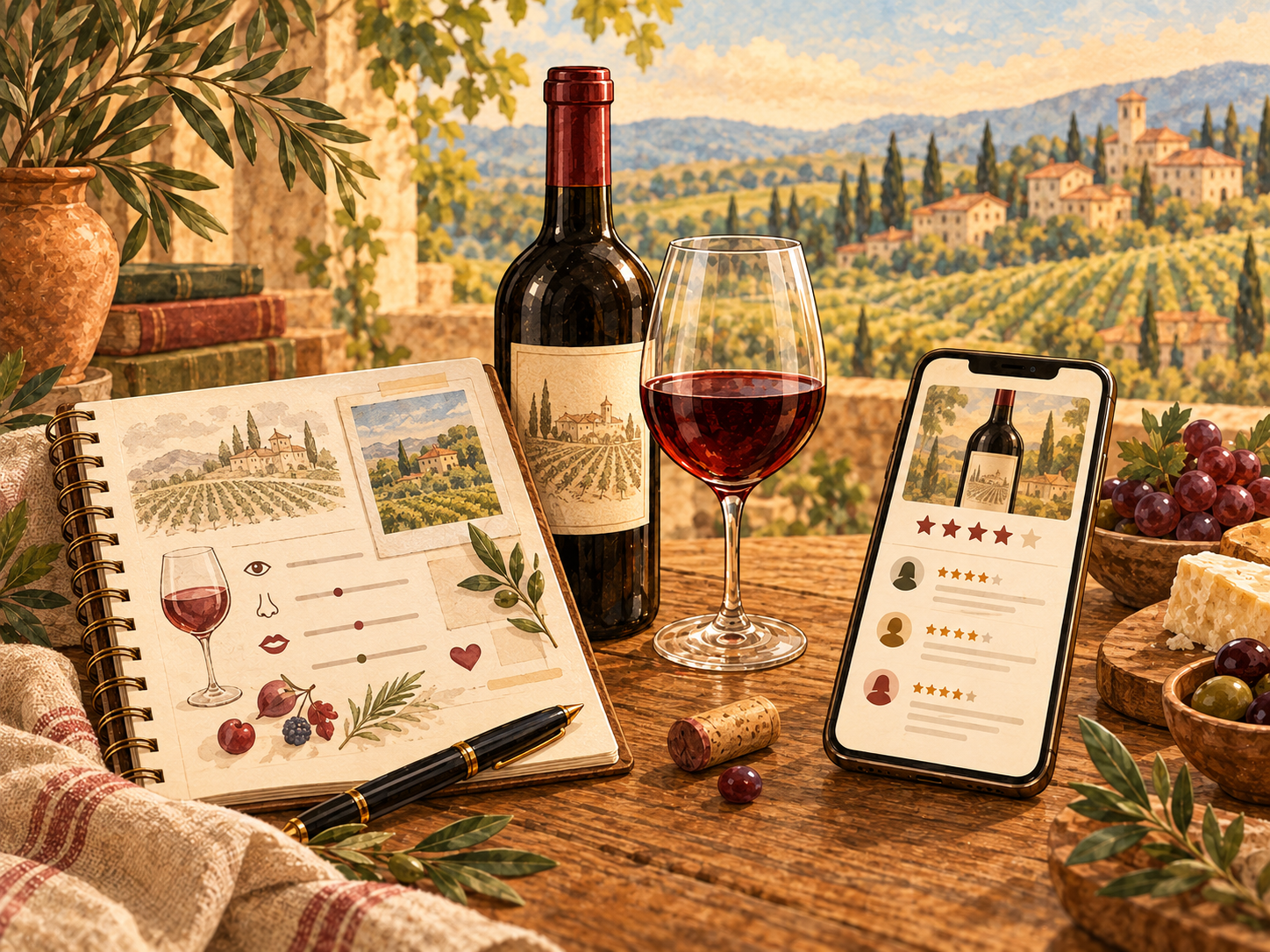
A wine rating app and a wine journal can both help you choose wine, but they answer different questions. A wine rating app helps you understand what other people think about a bottle. A wine journal helps you remember what you thought about it. That difference matters more than it might seem. A highly rated wine can still be completely wrong for your taste. At the same time, ratings can be useful when you are comparing unfamiliar bottles or want another opinion before buying something new. The goal does not have to be choosing one or the other. For most casual wine drinkers, ratings are useful information. Your own tasting history is what makes that information personal.
What Does a Wine Rating App Tell You?
Wine rating apps generally give you some version of an outside opinion about a bottle. Depending on the app, that might include:
Community ratings
Professional scores
Reviews
Tasting notes
Popularity
Price information
Food pairing suggestions
That can be genuinely useful. Imagine you are standing in a wine shop looking at two bottles you have never tried. One has consistently positive reviews while the other has very little information available. Those ratings can give you another signal when deciding which bottle to try. They can also help you spot wines that are generally considered good examples of a particular style. The important thing is understanding what the score actually tells you. A 4.3 star community rating tells you that a lot of people liked the wine. It does not necessarily tell you that you will like it.
Why a Highly Rated Wine Might Not Be Right for You
Wine is personal. Suppose a Cabernet Sauvignon has excellent reviews. People praise its structure, concentration and long finish. That sounds promising. But what if you usually prefer lighter reds with soft tannins and bright fruit? The Cabernet may deserve every positive review it received and still be a poor choice for you. The opposite can happen too. You might love an inexpensive bottle that receives fairly ordinary scores because it happens to have exactly the characteristics you enjoy.
Neither experience makes the rating wrong. You and the people providing the ratings are simply answering slightly different questions. The rating asks:
How good is this wine according to the people evaluating it?
Your personal history asks:
How likely am I to enjoy drinking this wine?
For everyday wine buying, that second question can be much more useful.
What Does a Wine Journal Tell You Instead?
A wine journal builds a record of your own experience. Instead of starting with what everyone else thinks, you can look back at things like:
Which wines you enjoyed
Which wines you disliked
What they tasted like to you
Grapes and styles you keep coming back to
How much you paid
Where you found the bottle
What you drank it with
Whether you would actually buy it again
That last question is especially useful. You might rate two wines 4 out of 5 but feel very differently about buying them again. Maybe one was a $45 bottle you enjoyed at a special dinner. The other was an $18 bottle you would happily keep at home for pizza night. The rating alone does not capture that difference very well. Your history does.
Wine Ratings and Personal Ratings Are Different Too
There is another distinction worth making: using ratings in a wine journal is not the same thing as relying on community ratings. Your own 1 to 5 rating is still useful. If you consistently give certain wines a 4 or 5, that becomes another piece of information about your taste. The important part is that the rating belongs to your history. It becomes even more useful when you add a little context. Instead of only recording “4 out of 5”, you might save “4 out of 5 — smooth, lots of dark fruit, not too tannic. Would buy again around $20”.
Now you have something you can actually use later. After several bottles, you might discover that many of your favorites are medium-bodied reds with softer tannins. Or maybe your highest-rated whites tend to be crisp, dry and citrusy. That is much more useful than knowing you tend to give wines four stars. If writing tasting notes sounds like too much work, How to Keep a Wine Journal Without Overthinking It shows how little you actually need to record.
Where Wine Ratings Are Most Useful
Ratings still have a place. They are especially helpful when you have little or no personal information to work from. For example, ratings can help when:
You are choosing between unfamiliar bottles
You want to see how other people responded to a wine
You are exploring a grape or region for the first time
You want another opinion before spending more on a bottle
You are looking for well-regarded examples of a particular style
Think of ratings as another clue rather than the final answer. If you already know that you prefer crisp, dry white wines, a highly rated crisp white might be worth investigating. A highly rated rich, buttery Chardonnay may be less relevant if you already know that style usually is not for you. Your preferences give the rating context.
Where Ratings Start to Fall Short
Ratings become less useful when the number replaces everything else you know about your taste. Imagine you are choosing between these two bottles:
Wine A
Community rating: 4.4
Full-bodied
Firm tannins
Dark fruit
Noticeable oak
Wine B
Community rating: 4.0
Medium-bodied
Softer tannins
Red fruit
Less oak
Which one should you buy? There is no universal answer. If your journal shows that you repeatedly enjoy medium-bodied reds with softer tannins and dislike heavily oaked wines, Wine B may be the better choice despite its lower rating. That is the limitation of using popularity as personalization. Ratings tell you something about the wine. Your history tells you something about the relationship between that wine and your taste.
Your Wine History Gets More Useful Over Time
The real advantage of keeping a wine journal appears after you have recorded more than a few bottles. One entry helps you remember a wine. Ten or twenty entries can start revealing patterns. Maybe you discover that you consistently like:
Pinot Noir more than Cabernet Sauvignon
Crisp whites more than rich whites
Fruity reds more than earthy ones
Wines with softer tannins
Bottles around $15–$25 that you can drink with dinner
You do not have to deliberately study your notes to make those discoveries. Patterns become easier to recognize simply because you have a history to look back on. That history can eventually help with a much more interesting question than whether one particular bottle was good: What kinds of wine do I tend to like? That is the foundation of Personalized Wine Recommendations Based on Your Taste.
Use Ratings to Explore and Your History to Personalize
The most useful approach is not to ignore ratings. Use them alongside what you already know about yourself. A simple process might look like this:
Start with your preferences. Think about wines you already enjoyed and what they had in common.
Use ratings as supporting information. Reviews and scores can help you compare your options once you have narrowed down the style you want.
Try the bottle. Your own experience matters more than whether your opinion matches the community score.
Save what happened. Record whether you liked it, why and whether you would buy it again.
Use that information next time. Every bottle gives you another clue about what works for you.
Over time, you rely less on completely random choices because you have your own experience to work from. If you are still figuring out those preferences, How Wine Recommendations Based on Taste Actually Work walks through the basic taste signals that can make choosing wine easier.
You Do Not Need to Pick the “Best” Wine
This is one of the biggest mindset shifts for beginners. You do not need to find the bottle everyone agrees is best. You need to find bottles you enjoy drinking. Sometimes those will also be highly rated wines. Sometimes they will be inexpensive bottles with average scores. Sometimes you will disagree completely with the reviews. That is normal. Ratings can help you explore wine, but your own experiences are what teach you your taste. The more you remember about the wines you actually drink, the less every trip to the wine aisle has to start from scratch.
Build Your Own Wine Memory With Somm Scribe
Somm Scribe is built around that idea. You can save the wines you try, record your rating and notes, mark whether you would buy the bottle again and start building a history of your own preferences. As that history grows, it becomes more useful for understanding the styles you enjoy and discovering what to try next. You do not have to stop looking at wine ratings. Just make sure someone else's score is not the only information you have.
Start your free Somm Scribe wine journal and begin building a wine history based on what you actually enjoy.
